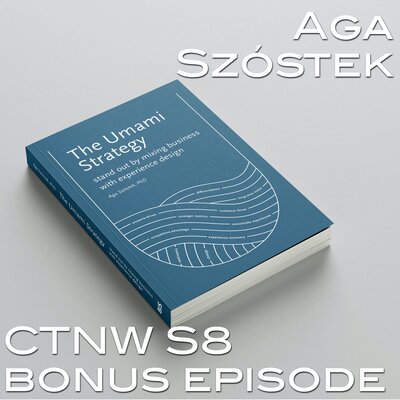
In this bonus episode, Aga Szóstek sits down with her co-host Łukasz to discuss her book The Umami Strategy: Stand Out by Mixing Business with Experience Design. The conversation goes well beyond a book announcement — it unpacks the core ideas behind the framework and why Aga wrote it for business people rather than designers.
Aga argues that most organisations measure customer experience poorly — relying on abstract scores like NPS without knowing what actually drives them. Her alternative: identify a small set of distinctive experience qualities (she calls them "edges" or differentiators) and deliver them with exceptional consistency. Not through one-off wow moments, which erode through positive adaptation, but as a steady, recognisable signature.
The episode walks through a real case study — a Polish bank that replaced blanket NPS monitoring with story-based measurement tied to six chosen differentiators. The result was granular, branch-level insight that NPS could never provide. Aga also explains the psychological trap of "wow effects" and why even spectacular customer experiences become invisible over time. The solution, she argues, is either a mission that transcends the product — like Patagonia's environmental commitment — or a set of well-chosen differentiators that give the organisation a clear internal compass.
The concept of umami itself comes from Japanese cuisine: a fifth flavour that doesn't stand alone but makes everything else taste more intense and complete. Applied to business, it describes what happens when purpose, differentiators and consistent delivery align — the organisation simply tastes better to its customers.
The Umami Strategy
Stand Out by Mixing Business with Experience Design — a practical framework for building a customer experience strategy that truly differentiates.
Aga Szóstek is a strategic experience designer who helps organisations develop and implement differentiated customer and employee experience strategies. She works with companies large and small — from Google, Samsung and Microsoft to Polish banks, telecoms and retailers — to create the stories their customers tell about them.
Alongside her consulting work, Aga designs and runs leadership programmes that help leaders build their own conscious practice. She is the author of two books: The Umami Strategy (2020) and Leadership by Design (2022/2023).
Lukasz: You wrote a book.
Aga: Yes, I did.
Lukasz: Why? No, let's start from the beginning. Welcome to another bonus episode of the Catching the Next Wave podcast. And our guest today is both very special and kind of usual because it's Aga. Hi, Aga.
Aga: Hi, hello.
Lukasz: How are you doing?
Aga: I'm doing good. It's a very strange introduction.
Lukasz: Yes. Because the reason we are having this recording is also strange, at least new. You wrote a book.
Aga: Yes, I did.
Lukasz: What's the book called?
Aga: So the title of the book is the Umami Strategy. Stand out by mixing business with experience design.
Lukasz: Umami Strategy.
Aga: Yes.
Lukasz: Stand out by mixing business with experience design. So it's a business book. It's not cookbook.
Aga: It's a business book. Although. I can imagine that there are a few ingredients that you can mix and get something very interesting out of it.
Lukasz: Okay. We'll get to the umami in a second. But is it something like a recipe book? Really? No, no, it's not. Why did you write? What on earth possessed you to write a book? How could you do this to me?
Aga: Yeah, you suffered through this, didn't you?
Lukasz: Took a while.
Aga: So actually, the idea of writing a book was something that I've been carrying with me for a very long time. Unconsciously, subconsciously, and unconsciously, you know, being a designer, I was imagined that I would write a book for designers. But when we moved to Poland, and we started working with business, I realized that that business doesn't know how to incorporate experience design into what they do.
Lukasz: So if the designers were really good at it, it was difficult to use it in a business context.
Aga: Exactly.
Lukasz: Right.
Aga: And I remember talking to one of my clients, a little bit impatient.
Lukasz: Oh, you were impatient or the client was impatient?
Aga: I was impatient.
Lukasz: Oh, you were, all right.
Aga: And I said, like, why don't we, why don't we do it faster? Like, why don't we introduce all this thinking about experience a bit faster in the organization? And the organization was ready. He was ready. And he said to me, Aga, everything that we are talking about, it really sounds good. I'm super convinced that what you're saying makes sense. It's gonna. It's gonna be a very valuable contribution to our organization. But you have to understand that I know how to run business. I know how to do finances. I know how to sell how I do business and how I do finances to my stakeholders. But I have no clue how to include everything that you are talking about into our strategy, our company strategy. And I remember, I really choked on those words and realized that perhaps this book that I've been thinking about shouldn't be the book for designers. It should be a book for business people who would like to bring experience design into the strategic level, like people working in marketing, people working in communication. There are a lot of different departments at different organizations that are willing to think about experiences as this differentiator on the market and help them to make it a strategic element. And I remember actually, when I wrote a book proposal and send it to one of our friends and guests on this podcast, Peter Abrahamsen, he read it and he said, like, Aga, it's very clear that you should write this book for business people, not for designers. And I said, OK, he probably sees it even sharper than I do. And then I decided to change it into a business book. That doesn't mean that this book doesn't serve designers. In a sense that a lot of designers suffer from the exact same thing I've been suffering for years, namely not finding the arguments to convince business about the strategic value of experience design. And in that sense, they get a lot of insight and a lot of tools that help them to have this communication and have this message conveyed to their business partners.
Lukasz: You mentioned something that this experience is not a strategy per se. It's more like an addition. To business strategy. Am I understanding this correctly?
Aga: Yes and no. This is a strategic element. But of course, any company, especially company, but generally any organization has more strategic elements than just experience. So this is one of the elements that should be added there. And interestingly enough, often when companies go for it, it's the element that makes all the other things work.
Lukasz: Just for the sake of understanding what we are talking. If you could give like one example of a company who went for it and how would you decode this experience design in that example?
Aga: So I cannot share the name here, but there is a bank in Poland who really wanted to be recognized through their what is typically called customer experience. And one of their departments contacted me. It was the service department. And they said that they run into trouble. They have been using, as many companies do, NPS, Net Promoter Score, as their customer experience measurement. But there's a lot of problems with Net Promoter Score. One of them being that it's like one measure, which is super abstract and super generic, and you just don't know what influences that measure. And even if you have a transactional NPS, meaning that you are measuring it at a particular point in the journey of your customer through your service, the thing is that this interaction happening at that point is influenced by all the other things that happen around. So you never really know whether you are measuring that particular thing or is there a luggage, a shadow that casts a shadow on that experience. In this particular case, the customer service of the bank was perceived very well. So basically the scores were between 92 or 94 and 96. And the maximum is 100, right? Maximum is 100, exactly.
Lukasz: That's suspiciously high, right?
Aga: It's extremely high. Extremely high, yes. And again, there is a number of problems with that measurement. I don't want to go into details of it. We could have a separate conversation about this, I guess. Anyway, first of all, they said like, OK, this is suspicious that we have it that high. And the second thing they said is like, should we then don't give a bonus to the people who got 92 or 94 and give the bonus to those who got 96? It doesn't feel right.
Lukasz: Yeah, let's not go into a bonus structure. That's yet another conversation, right?
Aga: Anyway, but that was their question. So they came to me and said, OK, like, could you help us use this umami approach of yours and help us to understand what's going on and how we can improve our customer service? And I said, yeah, of course. So basically what we did, we did a workshop where they chose differentiators that they want to be recognized by. And some of them were pragmatic. So, you know, like we have to be efficient. People shouldn't spend days at the bank. The other was we should be knowledgeable. So we shouldn't know what you're saying. So, you know, like some of them were like kind of basic, but there were also some that they seem like common sense, but they are less common sense. Like, for example, we are supposed to be empathetic. We are supposed to be human. So we should see a person on the other side and not necessarily a potential contract for mortgage. So basically, the idea was that you have this very personal connection and another thing was that. It's you personalize your communication. So depending on who comes, you're not going through the same formula of how you should communicate with your customers, but you basically adjust the communication. So if there is a young person, you communicate differently than when there's an elderly person coming to you. So there were six of those. And then, you know, there's always this moment in any organization that we kind of change the way to measure things. So I said, OK, how about we create measurements? Where, in fact, stories your customers tell and these stories will be the measurement for these six differentiators that you are betting on.
Lukasz: And those stories are kind of word of mouth, social media, this kind of stuff, like real one, not gathered in a lab under fluorescent light and behind the one way mirror, right?
Aga: So there were two ways to do it, and they went for both. One was to collect the spontaneous stories that people share. But of course, like when people share spontaneous stories, you cannot. Match them to the exact customer service situation. So they are more generic in that sense. So actually, there was a way to collect those stories through a phone call survey. Basically, people were answering questions, but they were also telling stories. So we did this and they said, OK, so we will keep on measuring NPS because this is our strategic measurement for the management board. But next to it, we will run a pilot and this pilot will be run quarterly for a year and we will see whether we get something interesting out of it. And that's all folks in a way, because when you are a consultant, you live at that point and you never hear from them again, but not in that case. Actually, a year later, they called me and they said that their trial period was over and that they realized how powerful it was. So on the one hand, they were able to see the differences among the different branches. So they were able to say, OK, these guys are really knowledgeable, but they're, you know, empathetic skill are kind of lacking. And at the same time here, maybe they are not that really good, but they are actually super kind and they know how to communicate with people. They have really good soft skills. So suddenly they were able to say, OK, like with these guys, we need to help them be more human in their approach and not like kind of computer machine. And with these guys, we have to train them because they apparently lack some basic information about our products. And they said, OK, we now see the power of having this kind of solution. And they said. They are not giving up NPS because that's a benchmarking measure for a lot of things, but they are putting those measurements as an additional explanatory measurements for where they want to go and how they want to be perceived by their customers.
Lukasz: If I just interject here. So the difference between what you propose and what NPS does in that case is that you rather choose how you want to delight your customers rather than just. Do your stuff, do a measurement and try to decompose from that measurement what is lacking. Yes, that's a different attitude. OK, got it.
Aga: But there is more to this. So one thing is that a lot of companies, a lot of organizations say like we measure customer experience. But what customer experience? There can be a bad experience, there can be unremarkable experience. So if you really don't know what kind of experience you want to deliver, it's very difficult to deliver something that's recognizable and standing out. But in the market, what I'm proposing is that it's really good to choose the few differentiators that you want to bet on, like in the case of this bank that I was mentioning and do them like really well, like not just one step ahead of a competition, but like the best in the world. Of course, you have to be on par with other aspects that are important for customers, like, for example, that you should be usable and people should understand what's going on or you should be reliable or you should deliver the functionality that they need or it should look decent at least.
Lukasz: So what you're saying, it should work as in not disappoint people and then you want to have this kind of remarkable aspects that really gets somehow noticed.
Aga: Exactly.
Lukasz: All right.
Aga: So for once, it's not a very novel concept. If anyone who works in branding listens to this, they say like, of course, we have the differentiators, but typically they're the communication differentiator and not the experience differentiator. So I'm not saying that they should be different. They can be the same.
Lukasz: They also have to be real, right? It's not.
Aga: Yeah, exactly. That's the point. And another thing that I'm saying is that there was this trend, I would say, in the field of customer experience that people go for wow effects. So basically they do something. It's like a momentary, spectacular thing. You get a Christmas card or a bonus or something like this, and it was supposed to make people like you. And of course, it doesn't work. It doesn't work for a number of reasons. One thing is that if you have either an unremarkable experience throughout or if you disappoint your customer a number of times along the way, one rose is not going to change it, right?
Lukasz: There is some magic ratio.
Aga: It's actually that if you have a healthy relationship in your marriage, you should have a ratio of one bad thing being said to the other person versus five positive things that are being said to the other person. So I guess the business is maybe not as hardcore as relationships. You don't spend your days and weeks and weekends with your bank comparing to how you spend it with your family. Anyway, but basically there is an idea that you have to deliver on something consistently so people feel that even if something doesn't go very well, that there is something to hope for, I would say. And there is another problem with the wow effects, and this is the psychological phenomenon. Of positive adaptation. So basically, if you get something remarkable today from your provider, tomorrow you will expect exactly that thing, right? So something that was like really spectacular yesterday, today is your new normal. So as humans, we basically get very quickly adjusted to new situations, especially if they are good for us.
Lukasz: Yeah, I can think of something that we experienced not so long ago was commercials on TV. I mean, we are off the normal networks. We can say we only watch Netflix, and then we have visited someone and we saw a commercial on TV and said, what the hell is that? For us, the normal is like no commercials on TV. And I don't know when it happened, and it happened quickly.
Aga: Yes, exactly. And then if you see a commercial, you are kind of annoyed with it, right?
Lukasz: Oh, yeah, I'm pissed.
Aga: So there is this problem with this positive adaptation that there is no way to stop it. So people will eventually get adapted to anything that you offer them. Like, no matter how good it is, over time, people will see it as the new normal. By the way, if you look at the whole history of Apple, when Apple first started producing MacBooks or iPhones or, you know, whatever other things that they were producing, people were saying like, oh, my God, this is like so spectacular. And right now, this is expected not only from Apple, but this is expected from everybody else that this will be the level of quality of design and of service that's being offered, right?
Lukasz: And packaging.
Aga: Yeah.
Lukasz: Actually, I have recently. Upgraded my laptop because it was really old one. By the way, they last a long time. So the utility is really great. And now when you mentioned this, I was expecting a good kind of unpacking experience and it didn't take away from the fact that it was, again, really nice and spectacular, but it wasn't a wow effect anymore. It was really pleasant, but I expected that. And if it wasn't there, I would say, oh, they're slipping.
Aga: That's bad, right? Exactly. So there are two ways to deal with it. One way. The second way is to have a goal, a mission that goes beyond delivering a great product. CSR. No. CSR is a nice add-on, but your customers have to believe that you are living and breathing your mission. Patagonia is a great example here.
Lukasz: So just having a foundation under the same brand name that no one recognizes or just not much hype about it is not going to cut it.
Aga: No, not really. You know, John Sinek talks about it a lot. He calls it knowing your why, or he talks about just cause a lot of people call it the North Star. But the thing is that it has to be something that you are really after and not just having it as a corporate statement on your strategic slides. Right.
Lukasz: I'm thinking now about any company that is trading on the stock market. It's probably not an option for them. It's really difficult, right?
Aga: It is. Yeah.
Lukasz: So what's the other option?
Aga: So it's not like one or the other. Oh. Unfortunately. Yeah. Unfortunately, I'm sorry to say that. However, what you can do is to choose your differentiators and say that you are going to be the best in the world. So the thing of the vision with this North Star that companies have is that it's kind of abstract and far fetched. So it's very easy to forget about it when you are doing your daily things and say, okay, like we are generally going there, but it has nothing to do with my daily work. Mm-hmm. These differentiators or edges, as I call them, after.
Lukasz: Yeah.
Aga: These are the things that set God in are the boundaries within which you produce whatever you produce. Imagine that you say that your experience should be cute, efficient and magical, right? Cute, efficient and magical.
Lukasz: Okay. Yeah.
Aga: I'm just pulling it out of my sleeve here. And then whatever you do for your customers, you have to have these three qualities present. Doesn't matter whether you're sending an invoice. Doesn't matter whether you're selling them something. Whether you are delivering.
Lukasz: Yeah.
Aga: The contract or.
Lukasz: Or someone from the customer service answering a phone.
Aga: Exactly. These three things have to be present. Mm-hmm. And then again, they probably are present with different intensity depending on where you are in the organization. But you need to remember about these three things. And they are like the edges, the borders of the path that you are choosing to get to your mission, to your North Star. And the good thing about these edges, these differentiators, is that as much as your North Star. It's always the same. It doesn't change. It can be better formulated. It might be more concretely explicated for your organization as you mature and you understand it better, but it doesn't change. With the edges, you can adapt them depending on how your competition behaves. Because, for example, you bet on being super cute, right? So you have all this like nice communication. You have like an avatar of your product showing everywhere and it's all super nice and people love it and people talk about it. And suddenly your competitor comes and finds a different way to communicate, which is super cute in a different way. And then you realize that with all the luggage that you've got, maybe you have some way of coding your chatbots. Maybe you have some ways of defining your IVRs and so on. That the cost of changing all of it and reshaping it will be too high to be ahead again. Or maybe you just don't have an idea of how to be ahead again.
Lukasz: So we exchange cuteness for something new. Which we will be definitely number one by far.
Aga: Exactly. And in that way, you direct your organization to deliver on the experience that's consistent throughout. And this is the thing that's super important for your customers. And I'm talking about B2C and B2B. So I'm talking about the end customers, like people buying in the shops, but also in the context of business to business, it also works. So basically, the idea is that people come with an expectation. They have expectations of having a cute or magical or efficient or whatever other experience. And when you deliver on it like hell, then they feel okay, like this is something they want to be attached to and connected to and use over time.
Lukasz: Yeah, I'm trying to figure out how new this approach is. And I'm thinking of all the counter examples, but the underlying thinking that you want to focus on something and then find a ways to deliver that something. That's not new, right?
Aga: No.
Lukasz: Because if you take, again, publicly traded company, one of their goals is definitely deliver value to their shareholders.
Aga: Yes.
Lukasz: And they do it. And if you look throughout the company, normally, like if this is their goal, there is all kind of stuff that is happening that is driving exactly this. But you are saying you need to have more than one, and it also should be focused on the customer. So that's the addition that you are proposing here compared to kind of classical. Classic approach.
Aga: Okay, so imagine that you are, and I'll use the example that you use a lot in your conversations with your clients. If you say that your goal is to earn money, why aren't you in drugs? Or insurances. Or insurances. This is the place to be. So if you are doing something else, you're probably doing it for a reason. And when you focus on the financial aspect, you tend to forget why are you doing this. Why are you doing what you are doing in the first place? So if you focus on the experience, you suddenly have a reminder of why you are doing what you are doing.
Lukasz: And where is the money coming from, right?
Aga: Yes. And the thing is that obviously it is focused on customers in the sense that you deliver something that makes your customers feel good. But it's not about pleasing the customer at all cost. So your goals can go beyond customers. So, for example, if you heard of Tom's Shoes. The goal is that you buy a pair of shoes and then the other pair of shoes is being sent to the people who need shoes and cannot afford them. And of course, you might question whether you totally like the design of the shoes or maybe the checkout or something like this. But you're coming and shopping there because you want to contribute to something else. So you want to help other people with your purchase to have shoes as well. So basically having these kind of goals that go beyond just being superficial. If you want to be super cute, for example, as we were using this example before, I'll come back to it, is something that's going to make your customers want to stay with you as well. So, of course, you need to delight your customers and make them feel like you kind of understand what they aspire to. But at the same time, if you help them to change the world in a way that they would like to change the world, but they don't have the means or, you know, they're just busy living their lives, they will like you. They will want to come back to you.
Lukasz: So let's try to summarize this a little bit. So the idea is twofold. One is to have a purpose beyond just immediate business. Another ingredient is betting on more than one aspect that will delight your customers while still providing solid service to not disappointing as they interact with you. Is there anything else in order to get the umami?
Aga: Yes. You have to know how to measure all the steps. The thing is that people measure different stuff as the representation of what their customers think about it.
Lukasz: It's like an example of NPS before.
Aga: NPS being one, conversion being second. And conversion doesn't really mean that the customers like you. They might choose you because you are the cheapest or they have no other choice. So basically, the whole idea is to understand that if you want to create experience, you need to be looking for the word of mouth, for the stories your customers tell about you. And to paraphrase. Dave Snowden, your goal is to get more stories like this and fewer stories like that. So the way to do it is to collect word of mouth, either spontaneously from your customers or collect it in some way, like in the case of the bank when they were having the phone surveys to collect the stories that the customers tell about the different branches. And then have a way to assess these stories and say, okay, like these stories really represent me. These stories represent our cuteness or our focus on helping local community. And once you see more of these kind of stories in what your customers tell, you are on the right track. And if they don't tell these stories, obviously you are not doing enough. So you have to turn it up.
Lukasz: Any more ingredients?
Aga: Of course, there are more ingredients. All right.
Lukasz: But for that, you have to read the book.
Aga: I guess so. Because, of course, there's the framework of saying what is the basics. What are the things that make people even want to consider being with you? What are the motivators? So what are the aspects that make people really want to stay with you, even if a cheaper competition or more convenient competition comes to the picture? There's also the mindset. So, you know, once you have your strategy created, you need to run with it, right? There's so many strategies that are written, again, on the corporate slides and never turn into anything tangible. So basically, there's quite a lot of things in the book that talk about how you can make it be alive throughout your organization.
Lukasz: So if I'm a new manager and I pick up that book, how is your book going to help me?
Aga: So the first thing is that it will explain to you what experience is. It will explain it in a psychological terms, but at the same time, it will make it very concrete in the context of business.
Lukasz: Okay. So you show me the context. You show me the connection to my worldview.
Aga: Exactly. Cool. The other thing is that you will get a set of tools and set of ways to create an experience strategy.
Lukasz: So there's actionable stuff there that I can use.
Aga: Yes. There's a whole part with tools, with explanations, with exercises that you can do in your workshops that will help you go through the whole process from collecting the user insights all the way to creating the measures for it. So you will get pointers into how to create this mindset of umami in your organization, which will basically mean that you need to change the way you communicate certain things, that you need to approach many of your projects in a way where you experiment with things, that you need to always check whether whatever you're doing is not jeopardizing your North Star and things like this.
Lukasz: Okay.
Aga: So that's the first part of the mindset. And the book ends with an exercise that's necessary before you actually get into the strategic part of the book, which is a reflection about like, where do you want to be as an organization? And the reflection journal designed especially for this is downloadable from my website, www.agasostek.com. So if you think about this book, it's really circular. In a way, it starts with the explanation and it ends with you reflecting on the explanations in the context of your business in order to create the strategy and then implement it in the organization.
Lukasz: Okay. So the last question, I think it's my third approach to trying to get the answer from you. What's the story with umami?
Aga: Probably you of all the people in the world know best that I love cooking.
Lukasz: Oh, yeah. Yeah. Our listeners don't know that. Unless they have been here and she cooks really well.
Aga: So after cooking for many years, I was trying to understand how the taste buds work, how we perceive different flavors and things like this. And there I bumped into this information that there is a flavor umami. It was discovered in the 50s of the 20th century in Japan. And I must say that this concept of umami. So not a separate flavor. Something that makes everything taste so much more delicious was something that really resonated with me. And I was thinking that, of course, you can think of customer experience or experience design as another department or another process or a customer journey going through your organization. But in fact, this is exactly like umami. So you have to bring everything together. And when you put experience on the top of this, when you go after those differentiators. If you have the purpose. that is driving your organization. Suddenly you, as an organization, you taste better to your customers. You actually get this something that makes you stand out from all your competition.
Lukasz: Thank you very much, Aga.
Aga: Thank you.
Lukasz: It was very strange having an interview with you.
Aga: Yeah. But you surprised me with a lot of questions, I must say.
Lukasz: Yeah, that's what I always try to do to our guests. So I cannot disappoint, really. Any special surprises for our listeners?
Aga: So the book is available right now on the publisher's website. It's bispublishers.com. And if you use the code umami20. No spaces. No spaces. 20 is the number. You will get 20% discount on the book. The book will also be available on Amazon from October 19th, 2020.
Lukasz: All of them?
Aga: No. It's so-called international premiere, which basically means it will be available on Amazon. It will be available on all the European Amazons. And then it will become available on Amazon.com on March 15th. 2021.
Lukasz: Okay. All the best. And I hope it really makes an impact.
Aga: Thank you very much. I hope it would. Because, you know, like, I believe that NPS, Net Promoter Score, was a good starting point for many organizations to think about customers. And I think that it's a time for an evolution to happen here and to go a step further. And I hope that Umami could be that step.